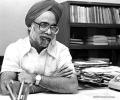
What stood out in his 15-year journey as a member of the political executive at the Centre was his glowing record as India's most successful and effective finance minister. Both as prime minister and finance minister, he understood the importance of gradualism, except when the economy or the polity was in a crisis.

'Regulatory challenges exist everywhere. What we look for is regulatory stability over time.'

Perhaps because the Modi government had some differences of opinion with two of the economist governors (one of whom was appointed by the Manmohan Singh government), there is a view that its political leadership prefers a civil servant to head the RBI, notes A K Bhattacharya.

A freebie once granted can hardly be discontinued. All that can happen is to substitute it with a bigger freebie, notes A K Bhattacharya.

As the Union government explores ways to restrict import of laptops and other electronic devices starting with a 5 per cent reduction from the current level, it is working to ensure that there's no supply disruption in India even if an import cap is introduced, it is learnt. The caveat assumes significance in the context of the government's announcement of its plan in August 2023 to issue licences for import of select IT hardware products to reduce the country's dependence on China.

Indications are that the Tata Sons stand on listing of the company may come up for a discussion even if it's not part of the agenda

Reliance Jio, the telecom business of the Mukesh Ambani-promoted conglomerate, is expected to go for an initial public offering (IPO) of over $6.25 billion either in the second or the third quarter of the calendar year 2025, sources said. Reliance Retail is likely to be listed around the same time with a short gap, it is learnt. The timing of the two IPOs, however, will depend on the company's assessment of the market conditions among other factors.

'While investors need to be prepared for making some losses, they should not lose big money chasing euphoria amid fear of missing out.'

Ratan Tata: A Life, the much awaited biography, reveals that after a year of 'parallel running', Tata began having second thoughts about Cyrus Mistry's 'suitability'. 'Mistry targeted Ratan, the man who had elevated him from virtual oblivion into the mainstream of the Tatas...'

'It would be reasonable to assume that Modi 3.0 would be more focused on projects and schemes which do not require any legislative change or which have the support of its coalition partners,' asserts A K Bhattacharya.

Whether it's Carrefour, Ford, or other foreign majors, they are ready to adjust their strategies and design their plans in a way that would address the Indian consumption story.

Why did the political system in the country react to these two decisions of the Modi government in a diametrically opposite manner? asks A K Bhattacharya.

Dr T V Somanathan is the first finance secretary to be appointed Cabinet secretary since 1985. His appointment at this juncture seems to carry much meaning for the forthcoming trajectory of reforms and restructuring of India's steel frame.

Few finance ministers announce any taxation measure that could upset the stock market. Ms Sitharaman decided to take that risk, observes A K Bhattacharya.

'We have essentially tried to set out an agenda for the next five years and it, in essence, represents the political commitment to that agenda.'

'I found it unbelievable that L&T said 45,000 jobs were waiting to be filled because of unavailability of suitable skillsets.' 'So, when the Opposition sweepingly says there are no jobs, I'm sorry... I'm not saying it's raining jobs, but there are jobs. The (skill) gap has to be bridged.'

With the fiscal deficit target staring at the government, the FY25 Budget has limited expenditure options, points out A K Bhattacharya.

The generation of quality jobs and skill development should be the focal point, cutting across ministries and departments, asserts Nivedita Mookerji.

The Budget should use the extra RBI surplus to better effect, suggests A K Bhattacharya.

In a move to deepen manufacturing in electronics in India, the Centre is targeting 35-40 per cent value-addition through the yet-to-be launched production-linked incentive (PLI) scheme for electronics components, sources in the government
 © 2025 Rediff.com - Investor Information - Advertise with us - Disclaimer - Privacy Policy - Sitemap - Feedback - About us - Terms of use - Grievances